Noisy Garage Door Repair in Smithtown, NY
A garage door that grinds, squeals or bangs every morning is usually telling you something. In the Town of Smithtown's split-levels and hi-ranches, where the garage sits under or beside the bedrooms, it's also waking people up. We find the source and fix it — tune-ups from $135, nylon rollers from $189.
How do you fix a noisy garage door? First find where the noise comes from: rollers, hinges, springs, the opener, or loose track. Then replace what's worn and lubricate the rest. Most quiet-door jobs are a tune-up (from $135), a set of nylon rollers (from $189), or swapping a chain opener for a belt or wall-mount model.
What Each Sound Usually Means
Grinding or rumbling as the door moves: worn steel rollers, or rollers rubbing a misaligned track.
Squealing or squeaking: dry hinges, dry roller bearings or dry springs. A squeal from the bar above the door can also be a worn center or end bearing.
Popping or snapping when the door starts: torsion springs that are dry and binding coil against coil. Lubrication helps; if it doesn't, the springs may be near the end of their life.
Rattling: loose hinges, track brackets or a loose chain on the opener.
Banging at the top or bottom: the opener's travel limits are off, or the door is out of balance and the opener is fighting it.
A loud hum, and nothing moves: that's the opener motor straining — often a broken spring or a stripped gear. See opener repair.
Quiet Garage Door Prices
We start with the cheapest fix that will work. On many doors, a tune-up and new rollers are all it takes. When the opener itself is the noise, a new one is the real answer.
| Service | From |
|---|---|
| Tune-up: lubricate, tighten, balance, test | from$135 |
| Full set of nylon rollers | from$189 |
| Hinge, each | from$49 |
| Center or end bearing plate | from$85 |
| Belt or chain slack adjustment | from$140 |
| LiftMaster 84505R belt drive, installed | from$565 |
| LiftMaster 8500W / 98022 wall-mount, installed | from$895 |
Every price on this site is a starting price. The final price depends on the door, the parts and the work needed, and you get it in writing before any work begins. The $45 service call is only charged if no repair is done. Sunday emergency calls add $45.
Garages Under the Bedrooms
From Nesconset to Commack, a big share of houses in the town are split-levels and hi-ranches. In a hi-ranch the garage is on the lower level with living space right above it; in a split-level it's often under a bedroom or beside the den. An opener bolted to the ceiling of that garage passes every vibration up into the joists.
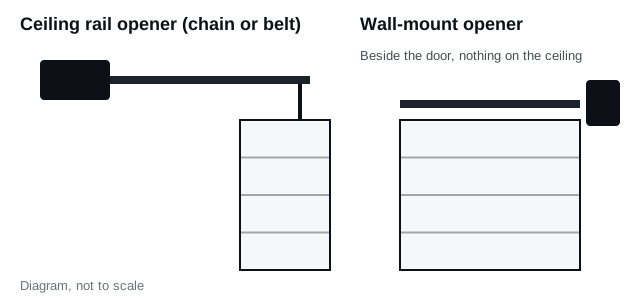
That is why the opener choice matters more here than in a detached garage. A chain-drive opener on steel rollers is loud in any garage; above a bedroom it's an alarm clock. Our options, from least to most work:
- Tune the door: lubricate, tighten, replace rollers. The door itself gets much quieter.
- Adjust the opener chain or belt and isolate the opener's hanger from the joists.
- Replace a chain-drive opener with a belt drive.
- Install a wall-mount opener on the spring bar, which removes the rail and motor from the ceiling.
Our guide to quiet openers for split-levels and hi-ranches goes deeper.
What You Can Do Yourself
A few things are safe for any homeowner and make a real difference:
- Spray a garage-door lubricant on each hinge pivot and each roller's bearing — not on the nylon wheel or inside the track.
- Lightly spray the torsion springs along their length.
- Tighten the nuts on hinges and track brackets with a socket — snug, not cranked.
- Wipe the inside of the tracks with a dry cloth.
Leave the bottom brackets and the spring hardware alone. Those are under tension.
If the noise is still there after a week, call us and describe it — the sound alone often tells us what to bring.
Noise That Means "Stop Using the Door"
A sudden loud bang followed by a door that won't lift is a broken spring. A grinding scrape with the door going crooked can be a roller leaving the track. A snapping sound from the side of the door can be a cable fraying. In any of these cases, stop, unplug the opener and call (631) 881-8120. These are covered on spring repair, off-track repair and cable repair.
What a Quiet-Door Visit Looks Like
We start by listening. The technician runs the door with the opener, then disconnects it and runs it by hand. That tells us quickly whether the noise is the door or the opener. Then we go part by part: each roller for wobble and flat spots, each hinge for cracks and loose bolts, the springs for dryness and binding, the bearings at each end of the spring bar, the track for alignment, and the opener's chain or belt, sprocket and trolley.
You get a written price for what will make a real difference, in order of value. Often the answer is a tune-up and new rollers. Sometimes it's an opener. We won't sell you an opener for a noise that rollers would fix.
Noise and Safety Go Together
A door that grinds, jerks or bangs is often a door that's wearing itself out. Worn rollers chew up the track; a door out of balance strains the opener's gear; a dry spring wears faster. Fixing the noise usually extends the life of the springs and the opener too.
And a quiet door is easier to keep an eye on: when a new sound appears, you'll notice it. That's often the first warning of a cable starting to fray or a spring near the end of its life.
Noisy Garage Door Questions
Straight answers with our starting prices. Last updated October 2026.
Why is my garage door so loud?
The usual causes are worn steel rollers, dry hinges, loose hardware, a chain-drive opener, or springs that need lubricating. A grinding rumble is often rollers; squealing is dry hinges or springs; a bang at the end of travel is usually the opener or a door out of balance.
How do I make my garage door quieter?
Lubricate the hinges, rollers and springs with a garage-door lubricant (not grease on the tracks), tighten the hardware, and replace worn steel rollers with nylon ones. If the opener is a chain drive, a belt-drive or wall-mount opener is much quieter. A tune-up starts at $135.
Is a belt drive garage door opener quieter than a chain drive?
Yes. A belt drive uses a reinforced rubber belt instead of a metal chain, so there is no metal-on-metal clatter. A wall-mount opener, which sits beside the door on the spring bar, is quieter still because it has no rail and trolley over the ceiling at all.
What lubricant should I use on my garage door?
Use a silicone or lithium spray made for garage doors on the hinges, roller bearings, springs and bearing plates. Don't grease the inside of the tracks — it collects dirt. And don't use plain WD-40 as a lubricant; it's a cleaner and dries out quickly.
Is a squeaky garage door a sign of a problem?
Sometimes it's only dry parts. But a new sound — grinding, popping, a squeal from the spring bar — can be a worn bearing, a cracked hinge or a spring near the end of its life. If lubrication doesn't fix it in a few days, have it checked.