Garage Door Spring Repair in Smithtown
Heard a bang in the garage and now the door won't go up? That is almost always a spring. We replace torsion and extension springs across the Town of Smithtown — one spring from $285, both from $489 — matched to what your door weighs today, with a 5-year warranty.
What should I do if my garage door spring breaks? Stop using the opener and don't try to lift the door by hand — the spring was carrying almost all of its weight. Leave the car where it is and call (631) 881-8120. Springs are on our truck, so most spring jobs are finished on the first visit, often the same day when a technician is free.
Torsion Springs and Extension Springs
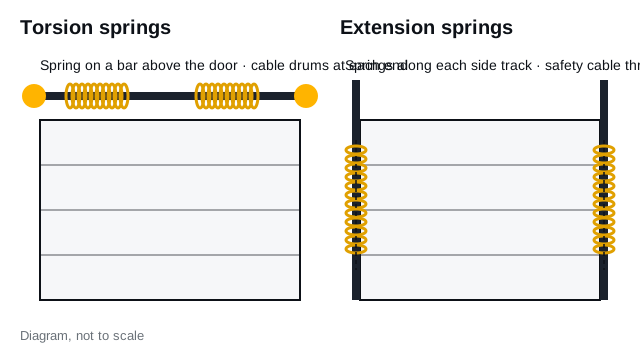
Look above your garage door from inside. If you see one or two thick coils on a steel bar running across the top of the door, you have torsion springs. Most doors installed in Smithtown in the last thirty years have them. When the door closes, the springs twist and store energy; when it opens, they unwind and turn the cable drums at each end of the bar, which lift the door.
If instead you see long springs running front-to-back above the horizontal tracks on each side, you have extension springs. They stretch as the door closes. You still find them on many original doors in the town's 1960s ranches and split-levels, and on lighter single doors.
Both types wear out the same way: by cycles. Each time the door opens and closes, the steel flexes once. Eventually it cracks. That is why springs so often snap on an ordinary morning, with no warning except perhaps a door that felt a little heavier lately.
Spring Replacement Prices
The price depends on the type of spring, the size the door needs and whether we replace one or both. A wide, insulated double door or a heavy wood door needs larger springs than a plain single door. Every spring job includes balancing the door, lubricating it and resetting the opener.
| Service | From |
|---|---|
| One torsion spring | from$285 |
| Both torsion springs What we recommend on most two-spring doors | from$489 |
| High-cycle torsion springs, pair For doors used many times a day | from$545 |
| Extension springs, pair, with safety cables | from$335 |
| Extension to torsion conversion | from$595 |
| Cables, pair (often worn when springs go) | from$205 |
| Door balance adjustment only | from$135 |
Every price on this site is a starting price. The final price depends on the door, the parts and the work needed, and you get it in writing before any work begins. The $45 service call is only charged if no repair is done. Sunday emergency calls add $45.
Coupon: 15% off spring replacement. Mention it when you call.
How We Size a Replacement Spring
A spring is not one-size-fits-all. It is chosen by the wire thickness, the inside diameter, the length, and how far it is wound, so that it balances the exact weight of your door. Too weak, and the opener strains and the door drifts down. Too strong, and the door flies up and won't stay closed.
Here is the catch we see on a lot of older houses: the door has changed since the springs were sized. Someone added insulation panels, a window section, a new layer of paint on a wood door, or replaced the bottom section with a heavier one. So we don't just copy the old spring off its tag. We weigh the door, measure the drums and the height, and pick springs that fit the door as it is now.
If the existing springs were never the right size — common when a door was serviced cheaply years ago — you'll feel the difference right away. A well-sprung door, released from the opener, stays put about halfway up and lifts with one hand.
Standard or High-Cycle Springs?
Standard torsion springs are generally rated for about 10,000 cycles. One cycle is one open and one close. Count your household's trips for a day — the school run, work, errands, the dog, the kids on bikes — and it's easy to see why some springs last fifteen years and others five.
High-cycle springs use a longer or heavier spring to spread the load, so each cycle stresses the steel less. They start at $545 a pair, compared with $489 for standard. If the garage is your family's main entrance, they usually pay for themselves by skipping the next replacement.
We'll tell you which makes sense. On a door that goes up twice a day, standard springs are fine.
Why Springs Seem to Break in Winter
Our phones are busiest on the first cold mornings of the year. Steel loses some of its flexibility in the cold, and a spring that is already near the end of its life is more likely to crack when the temperature drops. Add a bottom seal frozen to the driveway and the opener pulling hard against it, and the weakest part gives.
You can't stop a worn spring from breaking, but you can avoid helping it along: don't force a door that is frozen to the ground, keep the springs lightly lubricated, and have the balance checked before winter if the door has started to feel heavy. More in our winter garage door guide.
Waterfront homes in Kings Park, Fort Salonga and Nissequogue also see springs rust from salt air. Read about coastal garage door hardware.
What Comes With a Spring Job
- New springs sized to your door, wound and set.
- A look at both cables, the drums and the center and end bearings — when springs fail, these are often worn too.
- Lubrication of the springs, bearings, rollers and hinges.
- Door balance test with the opener disconnected.
- Opener force and travel reset, sensor and auto-reverse test.
- 5-year warranty on the spring replacement, in writing.
Spring Repair in Every Part of the Town
We replace springs from the bluffs in Kings Park to the industrial streets of Hauppauge, in Commack colonials, Nesconset split-levels and the larger estate garages of Head of the Harbor. Most springs for residential doors ride on our truck.
Door stuck shut on a Sunday with the car inside? That counts as an emergency — see Sunday emergency service. Cables snapped along with the spring? See cable repair.
Garage Door Spring Questions
Straight answers with our starting prices. Last updated October 2026.
How much does it cost to replace a garage door spring in Smithtown?
One torsion spring starts at $285 and both start at $489. High-cycle springs for a door used many times a day start at $545 a pair, and extension springs with safety cables start at $335 a pair. Spring replacement carries a 5-year warranty and our 15% spring coupon.
Should I replace both garage door springs at the same time?
On a two-spring door, yes in most cases. Both springs were installed together and have made the same number of cycles, so the second one is usually close behind the first. Replacing both costs less than two separate visits and keeps the door balanced.
How long do garage door springs last?
A standard torsion spring is typically rated for about 10,000 open-and-close cycles. At two trips a day that is well over ten years; at five or six trips a day it can be five years or less. High-cycle springs are built for many more cycles.
How do I know if my garage door spring is broken?
Look at the spring on the bar above the door. A broken torsion spring has a visible gap of an inch or two in the coils. Other signs: a loud bang from the garage, a door that lifts a few inches and stops, cables hanging loose, or an opener that strains and gives up.
What is the difference between torsion and extension springs?
Torsion springs sit on a steel bar above the door and twist to lift it. Extension springs run along the horizontal tracks on each side and stretch. Torsion springs are smoother, safer and last longer; extension springs are common on older and lighter doors and must have safety cables running through them.
Can you convert extension springs to torsion springs?
Yes. Converting an older door from extension to torsion springs starts at $595. It makes the door quieter and smoother and removes the long stretched springs that can whip loose when they break.